 English
  Español
  Português
  日本語
日本語  Français
  繁體中文
繁體中文  简体中文
简体中文 
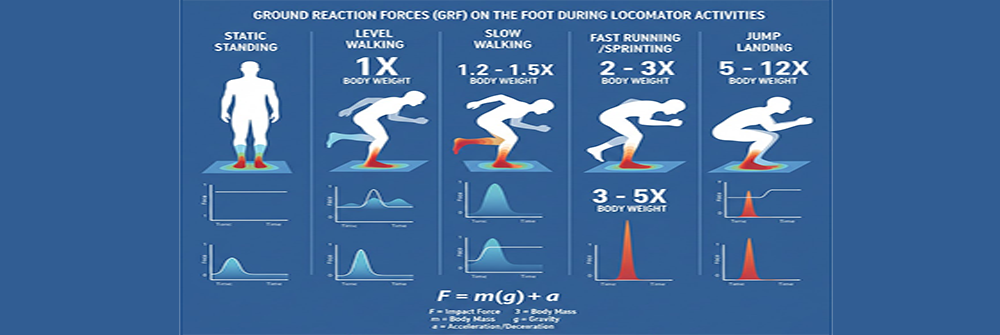
In biomechanics, the "weight" borne by the feet is known as Ground Reaction Force (GRF). When you move, the impact force on your feet increases exponentially with exercise intensity.
The following table shows the relationship between foot impact force and body weight under different movement states:
1. Comparison Table of Pressure Under Different Motion States
| Movement State | Foot Impact (Multiple of BW) | Impact Characteristics |
| Static Standing | 1x | Pressure is evenly split; each foot bears 0.5x body weight. |
| Walking | 1.2 - 1.5x | Typical "double-peak" curve: heel-strike and toe-off phases. |
| Jogging | 2 - 3x | Significant shockwaves; arches and ankle muscles absorb massive energy. |
| Sprinting | 3 - 5x | Minimal contact time; extreme peak pressure primarily on the mid-forefoot. |
| Descending Stairs | 3 - 4x | Due to gravity acceleration, impact on a single foot/knee is much higher than walking. |
| Jump Landing | 5 - 12x | Extreme load; depends on jump height and knee flexion for buffering. |
2. Why does "weight" increase during exercise?
This can be explained by the Impulse-Momentum Theorem in physics:
Where F is the impact force, m is your mass, and Δv is the change in velocity.
- Higher Velocity: The force F required to stop or redirect the body increases significantly.
- Shorter Contact Time (Δt): Forces are concentrated into a burst, causing a spike in instantaneous impact.
3. The "Leverage Effect" of Body Weight
A key biomechanical insight: The impact of body weight on the feet is amplified.
- Weight Loss Effect: For every 1 kg lost, the pressure on your ankles is reduced by ~3 kg per step when walking, and over 5 kg when running.
- Injury Risk: Excessive weight causes chronic over-stretching of the plantar fascia and Achilles tendon, leading to plantar fasciitis and collapsed arches.
4. The Body's "Shock Absorption System"
To combat these multiplied impacts, the body has evolved multi-level buffering:
- Foot Arch (Spring): Compresses and recoils like a leaf spring.
- Heel Fat Pad (Hydraulic Damper): Acts like a hydraulic shock absorber for the initial strike.
- Muscles (Active Absorption): Calf and thigh muscles use eccentric contraction to dissipate energy.
How Body Weight Affects Your Feet During Walking, Running, and Standing
Body weight has a significant impact on how pressure is distributed across the feet, especially during different types of movement.
Understanding how foot pressure changes during standing, walking, and running is essential for improving comfort, reducing fatigue, and designing better footwear and insoles.
Foot Pressure in Static Standing
When standing still, body weight is distributed relatively evenly across both feet.
However, pressure is typically concentrated in:
- The heel
- The forefoot
👉 Key characteristics:
- Stable pressure distribution
- Lower overall impact force
- Minimal dynamic stress
Foot Pressure During Walking
Walking introduces dynamic movement, which changes how weight is transferred across the foot.
The pressure follows a rolling pattern:
- Heel strike
- Midfoot transition
- Forefoot push-off
👉 Compared to standing:
- Increased pressure variation
- Repetitive load cycles
- Moderate impact force
Foot Pressure During Running
Running significantly increases the load on the feet.
At impact, the force on the foot can reach:
👉 2–3 times body weight
Pressure is concentrated in:
- Heel (or forefoot for some runners)
- Ball of the foot
👉 Key characteristics:
- High impact force
- Faster load transfer
- Greater stress on joints and muscles
Why Foot Pressure Matters
Uneven or excessive pressure can lead to:
- Foot fatigue
- Discomfort
- Reduced performance
In high-impact activities, proper pressure management becomes critical.
The Role of Insoles in Pressure Distribution
Insoles play a key role in managing how weight is distributed across the foot.
A well-designed insole can:
- Improve pressure distribution
- Reduce localized stress
- Enhance comfort during movement
🔹 Shock Absorption
Materials such as PU, EVA, and gel help absorb impact forces, especially during walking and running.
🔹 Arch Support
Proper arch support helps maintain foot structure and improves weight distribution.
🔹 Stability
Structured insoles improve stability and control during movement.
Choosing the Right Insole Based on Activity
🔹 For Standing
- Focus on comfort
- Moderate cushioning
🔹 For Walking
- Balanced cushioning and support
- Flexible structure
🔹 For Running
- Strong shock absorption
- Heel cushioning
- Stability features
Applications in Insole Design
Understanding foot pressure is essential in developing:
- Sports insoles
- Orthotic insoles
- Comfort insoles
- Functional insoles
👉 Different applications require different material and structural solutions.
Conclusion
Body weight affects foot pressure differently depending on the type of movement.
By understanding these differences, it becomes possible to design better footwear and insoles that improve comfort, stability, and overall performance.
Looking for High-Performance Insoles?
If you are developing insoles or looking for a reliable manufacturer:
👉 Explore our custom insole solutions or contact us for more information.